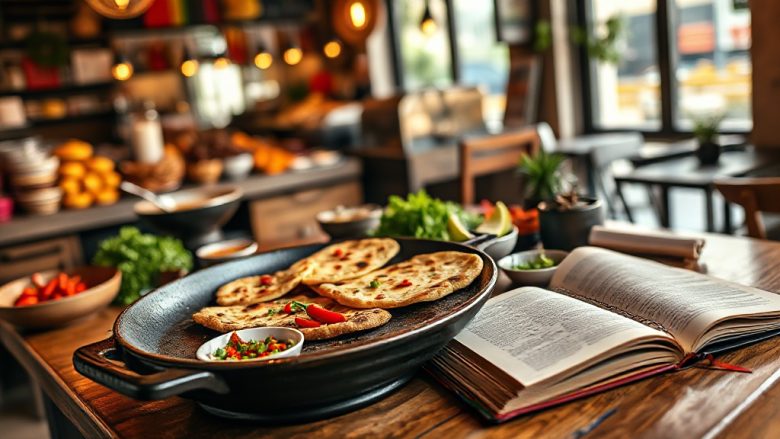
The smell hits you first. Charred corn and lime, cumin hitting hot oil, something sweet caramelising on a griddle. Street food is the most immediate kind of cooking there is — cheap, fast, made in front of you, eaten standing up. And the good news for anyone stuck at home with a normal kitchen is that you can learn it. The flavours travel. You just need the right resources, and the best resources for learning street food are easier to find than most people think.
This isn’t about recreating a Bangkok alley in your kitchen. It’s about understanding how the food works — the marinades, the salsas, the flatbreads, the griddle techniques — so you can cook it well at home and recognise a good recipe when you see one. Below are the resource types that actually teach you something, with notes on what to look for in each.
Books that teach technique, not just recipes
A cookbook is still the densest resource you can own. One good street food book will do more for you than a hundred saved videos, because it explains why things work. The problem is that most books labelled “street food” are travel books with a few recipes stapled on. You want the ones written by people who have actually cooked on a cart or spent serious time at one.
Look for three things. First, a chapter on pantry and equipment — if a book doesn’t tell you which chilli, which flour, which oil, it’s probably not going to teach you much. Second, technique notes attached to individual recipes: how hot the pan should be, why the dough rests, what happens if you skip a step. Third, a section on sauces and condiments. Street food lives or dies on its sauces, and a book that treats them as an afterthought is missing the point.
Regional focus beats global sweep. A book devoted to Mexican antojitos, or to Indian chaat, or to Southeast Asian grills will go deeper than a glossy world tour. Start with one cuisine you already eat often, learn its core ten techniques, then move sideways. Two or three well-chosen books will cover more ground than a shelf of general titles.
Secondhand bookshops and library sales are goldmines here. Older regional cookbooks often have better technique writing than modern ones, because they were written before food photography took over the page count.
Online video and channels worth your time
Video is where street food cooking really comes alive, because so much of it is about movement — the flick of a wok, the speed of a taco assembly, the way dough gets slapped onto a hot surface. You can read about that for years and still not get it. Watching someone do it at full speed, then in slow motion, is worth more than any written description.
The trick is filtering. Search results are full of restaurant-style versions of street dishes, which are usually too refined and too slow. What you want are channels that show the actual street version. Signs to look for: the cook is working in a small space, the equipment is basic, the quantities are eyeballed rather than weighed, and the finished dish is eaten on the spot. If a video spends more time on plating than on the cooking, skip it.
Long-form videos beat short clips for learning. A twenty-minute video where someone makes a batch of dough, talks through the resting time, then cooks it three different ways will teach you more than fifty fifteen-second clips. Watch the whole thing once without cooking, then again with your ingredients out. Pause at the moments that matter — the colour of the oil, the sound of the pan, the texture of the dough.
Subtitles are your friend. Many of the best street food cooks online are working in their own language, and auto-translated subtitles will get you most of the way. The technique is visible even when the words aren’t perfect.
Hands-on classes and market stalls
At some point you have to cook in front of someone who knows more than you. A class compresses months of trial and error into an afternoon, mainly because someone can correct your dough before you’ve wasted three batches of flour on it.
What to look for in a class: small groups, a cuisine with a specific focus rather than a “world street food” sampler, and a tutor who has cooked professionally rather than just travelled. Ask whether you’ll be making sauces from scratch, and whether you’ll get to taste as you go. A good class sends you home with a technique you can repeat, not just a nice memory.
Market stalls are the underrated option. If you have a decent street food market near you, become a regular at one or two stalls and ask questions during quiet moments. Most vendors are happy to talk about their food when there’s no queue. You won’t get a formal lesson, but you’ll pick up details — which brand of tortilla press they use, why they rest their meat overnight, how they keep their oil at the right temperature — that no book will tell you. It’s also the fastest way to taste what you’re aiming for.
Pop-up workshops and community college courses are worth checking too. They’re cheaper than branded cookery schools and often taught by people who cook this food at home every week.
Travelling, eating and taking notes
If you can travel, eat where the food is made. That sounds obvious, but the way you eat matters. Don’t just order the famous dish. Watch the stall for ten minutes before you order. Note the order of operations: what goes on the heat first, what gets assembled cold, how the sauce is applied. Take a photo of the stall, not just the plate — the setup tells you more about the technique than the finished dish does.
Keep a notebook. Write down what you tasted, what you think was in it, and what you’d change. This sounds fussy; it isn’t. Memory for flavour is unreliable, and a page of notes from a trip will be more useful to you a year later than a camera roll of food photos. If you can, buy a cheap local ingredient you can’t get at home and bring it back — a bag of dried chillies, a jar of paste, a specific spice blend. Cooking with it will anchor the memory.
When you can’t travel, eat locally with intent. Find the restaurants and takeaways in your city that cook for their own community rather than for tourists. Order things you don’t recognise. Ask what’s in them. That’s a form of research, and it’s free.
How to practise so it actually sticks
Resources only work if you cook. The single most useful habit is to pick one dish and make it repeatedly until it’s yours — not once, not twice, but five or six times over a few weeks. Street food rewards repetition because the techniques are small and physical: the way you fold a dumpling, the timing on a flatbread, the point at which onions go from raw to sweet.
Keep a simple log. Date, dish, what you changed, what worked. After a month you’ll see patterns — your pan is never hot enough, your sauce is always under-seasoned, your dough is always too dry. Those patterns are the real curriculum.
Cook for other people when you can. Feedback is data. And don’t be precious about authenticity. Street food is a living thing; every cook adjusts. The goal isn’t to replicate a stall in another country. It’s to understand the food well enough that your version tastes like it belongs to the same family.
Start with one cuisine, one book, one channel, one dish. That’s enough to begin, and it’s more than most people ever do.
Frequently asked questions
Do I need special equipment to cook street food at home?
Rarely. A heavy frying pan or griddle, a wok if you’re cooking East or Southeast Asian food, a sharp knife and a decent set of bowls will cover most dishes. A pestle and mortar is worth buying if you get into Thai, Mexican or Indian cooking, because pastes and salsas made by hand taste noticeably different. Skip anything single-use until you’ve cooked the dish at least three times.
Which cuisine is easiest to start with?
Mexican antojitos are a good first stop — tacos, quesadillas and simple salsas teach you about heat, acid and balance without needing specialist equipment. Indian chaat is also beginner-friendly once you’ve stocked a few spices. Thai and Chinese street food are harder at the start because they rely on wok heat and fast timing, but they’re very rewarding once you’ve got the basics.
How do I know if a recipe is authentic?
Look at the ingredient list and the method. Authentic street food recipes tend to be short, use cheap cuts and everyday staples, and rely on technique rather than long lists of exotic ingredients. If a recipe calls for a dozen things you’ll never use again and takes three hours, it’s probably a restaurant version. Cross-check against two or three sources — if they broadly agree on the core method, you’re on solid ground.